
The Wisconsin Transit Riders Alliance is a coalition of transit advocates and transit advocacy organizations, drivers and non-drivers, who share a common interest in state-level transit policy and finance. Public transit agencies may be local and local governments may be the decision-making face the public sees, but those entities are impacted in multiple ways both positively and negatively by state-level policy and finance. As transit riders in the state, we must ally ourselves to voice a state level message: We want more and better local transit service and amenities (paratransit, shared-ride taxi, vans, buses, streetcars, rail) and more and better intercity bus and train service and amenities.
We believe that a variety of transportation options, including good public transit, should be available so all people and businesses can consider convenience, time, health, accessibility, sustainability, safety and cost when choosing how to travel. Good public transit supports the dignity and freedom of all individuals, promotes participation in our society, creates an open, hospitable and welcoming community, respects the environment, opens economic opportunity to all and moves people to where they need to go.
To paraphrase from an opinion piece by transportation planner Colin Drake that appeared in 2023, the reason our Alliance exists is to:
- Use our political power. Transit riders, due to our sheer number, should be an influential voting bloc, but we aren’t. In partnership with advocates and media, we support elected officials and decision-makers who are trying to help and apply pressure to those who aren’t.
- Reject learned helplessness. We believe that change is possible, that by working with advocates and media, staff and consultants, and elected officials and decision-makers, the transit system we need will be the one we get.
- Learn. We can’t demand what we don’t know. Supported by staff, consultants, advocates and media, we are learning how to demand reasonable (a) Service (frequency, span); (b) Routing (directness, proximity to destinations); (c) Fares (cost, enforcement); (d) Priority (transit speed and reliability); (e) Information (wayfinding, real-time schedule); (f) Capacity (more/larger transit vehicles); (g) Access (first/last mile connections, sidewalks/elevators/escalators); and (h) Coordination (bus/rail connections, compatibility between systems) among other things.
- Challenge common myths Myths include the notions (a) that public transportation is only viable in urban areas, (b) that public transportation is synonomous with welfare while road construction is not, (c) that an efficient public transit agency is run like a for-profit business, (d) that the goal of public transit should be to maximize profit rather than maximize the public good, and (e) that the main beneficiaries of good public transit are transit riders themselves.
Wisconsin Transit Riders Alliance was established in 2013 in reaction to the Legislature’s hostile dismantling of efforts to improve public transit in Wisconsin while the then-governor averred that “everyone should drive a car.” It is a nonstock D-corporation in the state of Wisconsin with ID WO61452. It has 501(c)(3) IRS status and an EIN of 46-3987580. Our mission is to to engage in research, education, partnership, and advocacy with the goal of making Wisconsin transit as safe, efficient, clean, sustainable, accessible and affordable as possible. We also have a public discussion group open to everyone (members and nonmembers alike) on Facebook at https://www.facebook.com/groups/189958811633915.
- Board of Directors
- Bylaws
- Policies
- Plans
- Positions
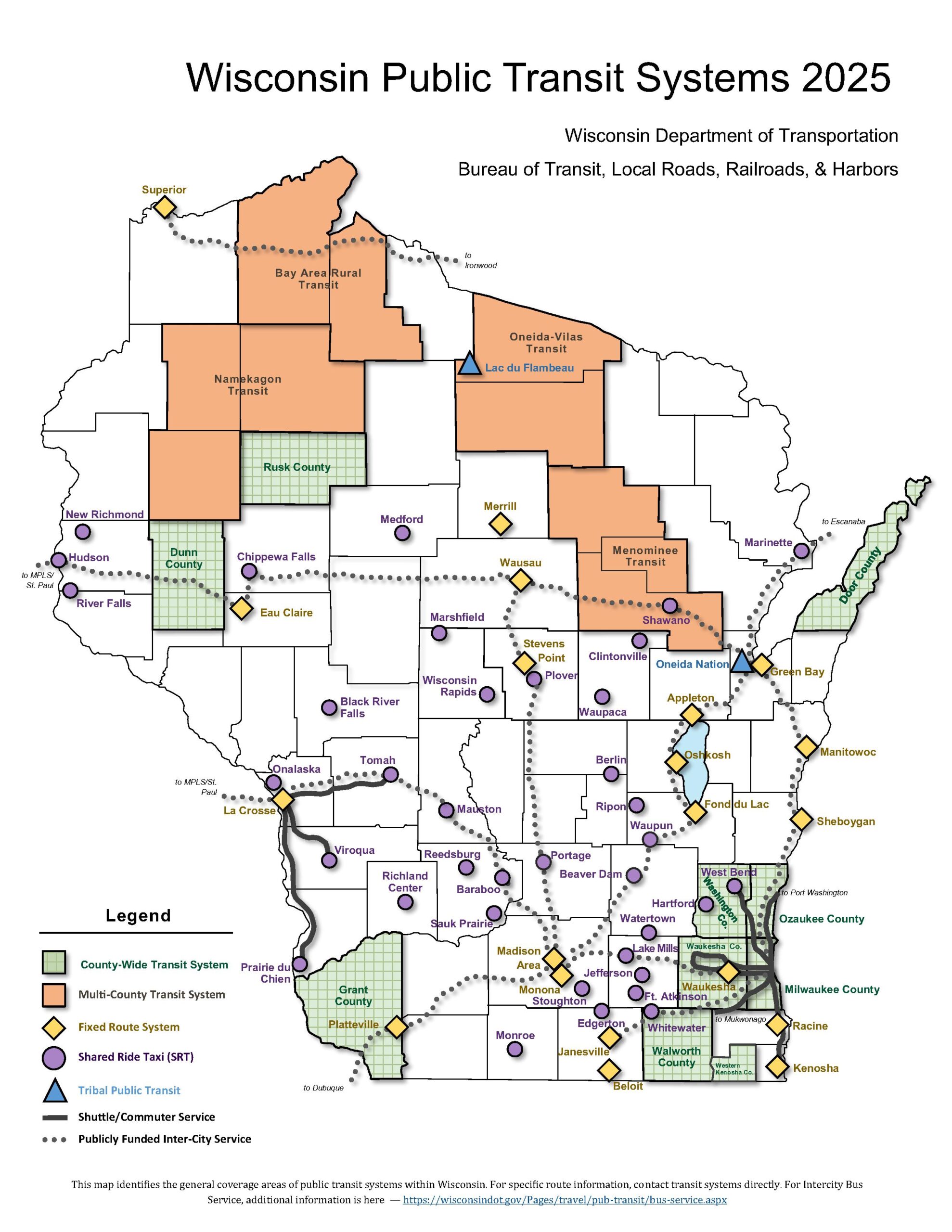
A map of Wisconsin’s public transit systems from the state’s Department of Transportation shows the existence of many transit routes and transit areas throughout the state:
Our potential is huge. So far, we have three chapters: Chippewa Valley Transit Alliance, La Crosse Area Transit Advocates, and Madison Area Bus Advocates. Our state (and now federal too) legislature has been unfriendly toward anything that does not involve driving an automobile. It even took transit out of the Transportation Fund (in effect back to being a Highway Fund). We need your voice and your vote to change that. Fill out this FORM and join us.
Page Last Updated March 16, 2026